Ice Dams in the Cascade Foothills
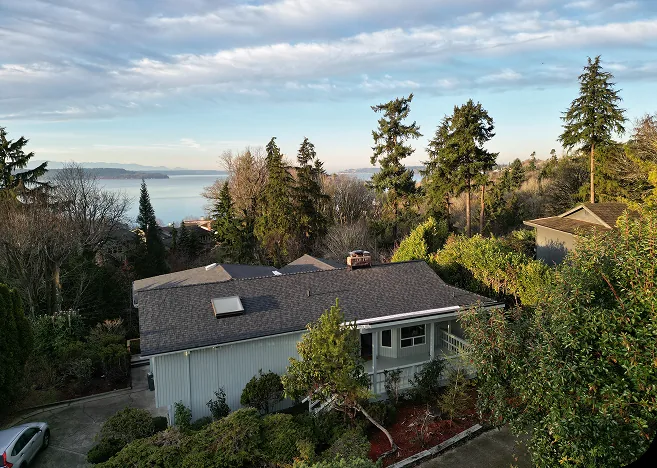
The lowlands rarely see ice dams. Thirty miles east they are an annual risk, and the two things that prevent them cost little during a replacement.
Most roofing advice written for this region quietly assumes you never get real snow. For most of the Puget Sound lowlands that is roughly true.
Drive thirty miles east and it stops being true. North Bend sits at the foot of Mount Si where the valley runs into the Cascades. Granite Falls sits at the edge of the Mountain Loop country. Both get snow that stays, and staying is the part that matters.
What an ice dam actually is
It is not really a snow problem. It is a heat problem.
- Snow sits on the roof.
- Heat escaping from the house warms the upper part of the roof deck — the part over the living space.
- Snow on that upper section melts, and the water runs down the slope.
- It reaches the eave, which overhangs open air and stays at outside temperature.
- It refreezes there, building a ridge of ice.
- The next meltwater hits that ridge, pools behind it, and has nowhere to go but sideways and backward, under the shingles.
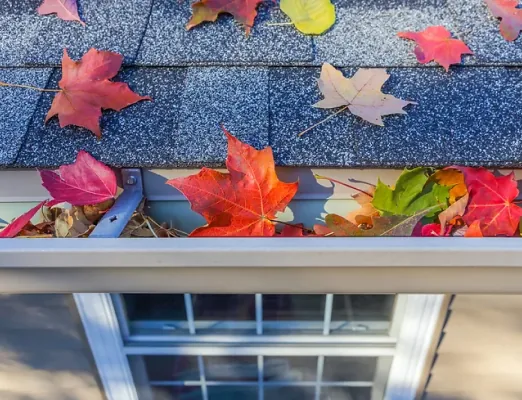
Shingles shed water going downhill. They are not designed to hold back standing water, and they do not.
The damage does not show up during the freeze. It shows up as a ceiling stain during the thaw, often several feet in from the exterior wall.
Why it is worse in the foothills
Three things compound at elevation:
- Snow sits longer, so there is more melt-refreeze cycling rather than one clean thaw.
- Temperatures swing across freezing repeatedly, which is exactly the condition that builds ice. A steady deep freeze is less damaging than a week of days above and nights below.
- Rainfall is higher, so everything the roof does, it does more of.
A house in Bothell might see this once a decade. A house up the hill from Granite Falls can see it most winters.
The two things that prevent it
Both are cheap during a replacement and awkward or impossible to retrofit afterward.
Ice and water shield at the eaves
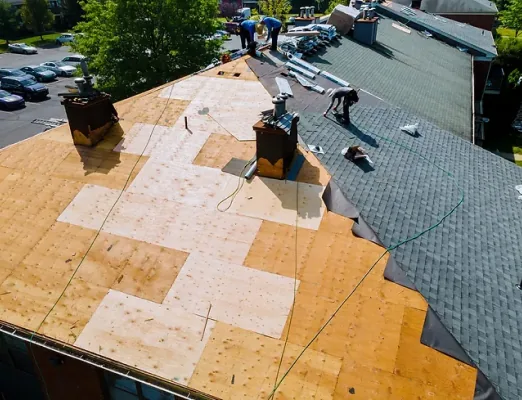
A self-adhering waterproof membrane that goes down on the deck before the underlayment, running up from the eave edge and into the valleys.
Where normal underlayment sheds water, this seals around the nails driven through it. So when water does back up behind an ice ridge, it meets a surface that is genuinely waterproof rather than one that is merely water-shedding.
On a lowland roof this is good practice. In the foothills it is the specification, and a bid that omits it is not comparable to one that includes it. How to spot that and other omissions is here.
Attic ventilation
This is the one people skip, and it addresses the actual cause.
Ice dams form because the upper roof is warm. Keep the roof deck cold — as cold as the outside air — and the snow on it does not melt in the first place. That means continuous intake at the soffit and exhaust at the ridge, with a clear path between them.
Common things that break it:
- Insulation stuffed into the eaves, blocking the soffit intake
- Bathroom or dryer vents discharging into the attic instead of outside
- Exhaust vents added over the years with no matching intake, so nothing actually moves
Ventilation is worth asking about specifically. If a roofer bidding on a foothill house has nothing to say about your attic, they are quoting shingles rather than a roof.
What not to do
Do not chip at it. Every winter someone goes after an ice dam with a hammer or a hatchet and puts a hole in the roof they were trying to protect.
Do not throw salt on the roof. Rock salt is hard on metal flashing, on gutters, and on whatever is planted below the eave.
Do not get on a snowy or frosted roof. A roof rake used from the ground, pulling snow off the lower few feet, is the safest thing a homeowner can do and it genuinely helps — it removes the material that would otherwise melt and refreeze at the edge.
If water is already coming in, the priority is limiting what it reaches inside. Put something under the drip, move what you can, photograph it for insurance, and call.
If your roof is due anyway
If you are in North Bend, Granite Falls, Monroe, Maple Valley or Bonney Lake and the roof is approaching the end of its life, the replacement is the moment to fix this properly. Eave protection and ventilation cost very little as part of the job and a great deal as a standalone retrofit.
Book a free inspection and we will tell you what your roof has now and what it is missing.
Written by the Brixton & Windsor Roofing crew. We are a family owned, CertainTeed ShingleMaster™ PRO roofing company in Bothell, and Daniel does every estimate himself. If something here applies to your roof and you want a second opinion on it, the inspection is free.