Why Your Roof Leaks Nowhere Near Where the Water Comes In
The stain on your ceiling almost certainly did not start above it. How water actually travels is what separates a real repair from a patch that fails.
A homeowner finds a brown stain on a bedroom ceiling and reasonably concludes there is a hole in the roof above that bedroom.
There almost never is.
Water travels sideways
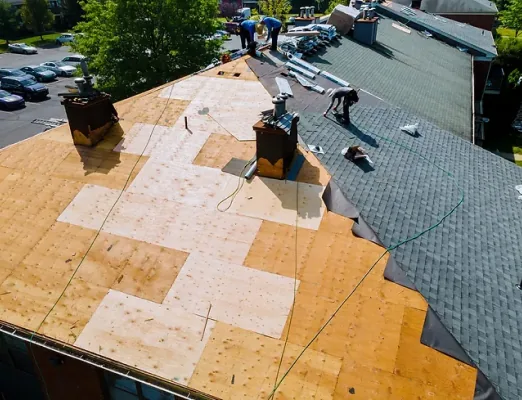
Once water gets past the shingles, it lands on the underlayment or the deck and then it does what water does: it follows the path of least resistance. On a roof, that path is almost never straight down.
Water will run along a rafter for ten or fifteen feet before finding a gap. It will follow the underside of the sheathing across several joist bays. It will run down a pipe, along a wire, or across the top of a ceiling until something interrupts it — and that interruption is where you see the stain.
The stain marks the exit, not the entrance. Anyone who goes straight to the ceiling and patches the roof directly above it is guessing.
Where it actually gets in
In this region, overwhelmingly at a detail rather than in the middle of a slope:
Flashing at a roof-to-wall junction. Where a roof plane meets a vertical wall — beside a dormer, at a second-story wall, along a chimney. This is the single most common source we trace. It should be step flashing, layered piece by piece with each shingle course. When someone has instead run a continuous strip and sealed it with caulk, it fails.
Chimney flashing. Four separate details on one chimney — the front apron, the two sides, and the back pan, which is the hardest and the one that fails. On an older chimney there should also be counter-flashing set into the mortar.
Penetrations. Plumbing vents, bath fans, attic vents, satellite mounts. The rubber boot on a plumbing vent has a working life considerably shorter than the roof it is sitting in, and a cracked boot is one of the most common leaks on a roof that is otherwise fine.
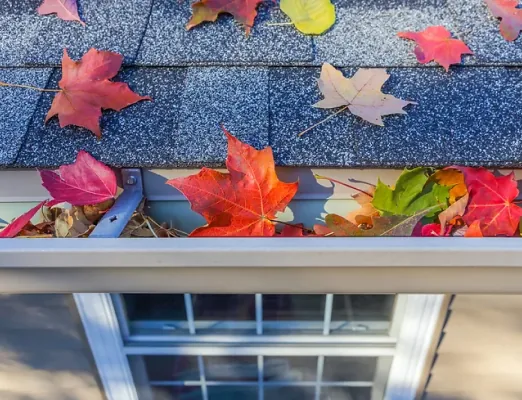
Valleys. Where two roof planes meet, a valley carries the runoff from both. It is the highest volume path on the roof, and when needles and debris dam it, water backs up and goes sideways under the shingles. On heavily treed lots in Sammamish or Bothell, this is a routine find.
Skylights. Almost always the flashing rather than the unit. Detailed here.
The eave, backward. Water can be pushed back up under the shingle edge by wind, by a packed gutter, or by ice. This is why drip edge, gutter apron and ice and water shield exist.
What it means when it only leaks sometimes
The pattern tells you a lot:
- Only in wind-driven rain — water is being pushed sideways or upward. Suspect flashing, the eave edge, or a wall junction.
- Only in heavy sustained rain — something is being overwhelmed. Suspect a blocked valley or a gutter backing up.
- Only after snow, during a thaw — ice damming. Common at elevation, rare in the lowlands.
- In dry weather, or worse in winter — this may not be a leak at all. Condensation from poor attic ventilation produces the same stains, and no amount of roof repair will fix it.
That last one matters. We have been called to “leaks” that were a bathroom fan discharging into an attic instead of outside.
How we actually trace one
Start at the stain, then work upslope, because water came from somewhere above it.
Go into the attic with a light on a dry day and look at the underside of the sheathing. Water leaves a trail — staining, mineral deposits, darkened wood — and that trail leads uphill toward the entry point. Then match what the attic says against what is on the roof directly above it.
Only then does anything get opened up.
This is why a real repair takes longer than a patch, and why patches so often fail: the patch was applied where the water appeared rather than where it entered.
What this means for getting a quote
Be wary of anyone who quotes a leak repair over the phone, or who is on the roof for ten minutes and produces a number. Finding the source is most of the work.
Our position on this has not changed since the company started: we will not push you into a replacement if a repair will genuinely extend the life of the roof. Most repairs run $500 to $1,500, and if your roof still has years in it, that is what the estimate will say.
Book a free inspection and we will find where it is actually getting in.
Written by the Brixton & Windsor Roofing crew. We are a family owned, CertainTeed ShingleMaster™ PRO roofing company in Bothell, and Daniel does every estimate himself. If something here applies to your roof and you want a second opinion on it, the inspection is free.