Why Pressure Washing Your Roof Is the Worst Thing You Can Do to It
Moss is the single biggest threat to a Puget Sound roof, and the most common way homeowners deal with it takes years off the roof in an afternoon.
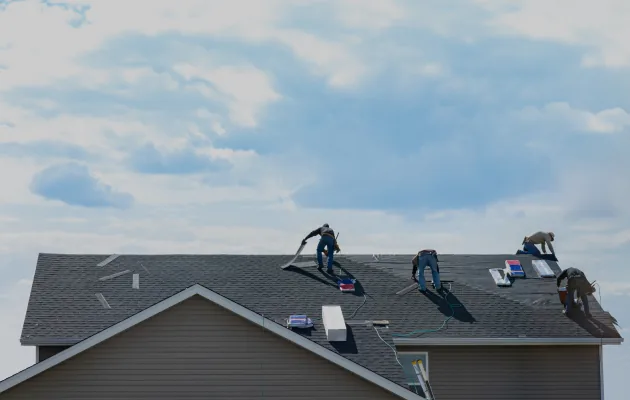
Every spring, somebody in your neighborhood rents a pressure washer and blasts the moss off their roof. It looks fantastic for about a week.
What actually happened is that they traded several years of roof life for one afternoon of curb appeal. Here is why.
What the granules do
Look closely at an asphalt shingle and the surface is covered in fine mineral granules — a coarse, sandy layer bonded to the asphalt underneath.
Those granules are not decoration. They are the shingle’s sunscreen. Asphalt degrades under ultraviolet light, and the granule layer is what stands between the sun and the material doing the waterproofing. It is also what gives the shingle its fire rating and a good part of its impact resistance.
A pressure washer strips them off. Not all of them, and not evenly, which is worse — you end up with a patchwork of bare and covered areas, and the bare ones start aging immediately.
If you have ever pressure washed a roof and seen black grit washing into the gutters, that was not dirt. That was the roof.
Why moss has to go anyway
None of which means you can leave it.
Moss is not a cosmetic problem on a Puget Sound roof. It grows in a mat that holds water directly against the shingle surface, and this is a climate where staying wet is the default condition from October to May. Worse, as it thickens it works under the shingle edges and lifts them. Once an edge is lifted:
- Wind gets underneath and breaks the adhesive seal
- Water gets underneath and reaches the underlayment
- The shingle is now doing far less than it was designed to
Left alone long enough, moss will take a roof that had nothing else wrong with it and shorten its life by years.
Soft washing, which is what we actually do
Soft washing uses low pressure and an appropriate cleaning solution rather than force. The solution kills the growth and it releases over the following weeks rather than being blasted off in one go.
It is slower and less immediately satisfying than a pressure washer. It also leaves the granules where they belong.
A few things worth knowing:
- It will not look perfect the same day. Dead moss keeps releasing for a few weeks after treatment and rain finishes the job.
- The gutters and valleys get cleared at the same time. Otherwise the debris washes down and dams up where it does the most harm.
- Steep and heavily shaded roofs take longer. Pitch and access drive the time more than area does.
Zinc and copper strips: do they work?
Partly, and it is worth being precise about it.
A strip of zinc or copper at the ridge releases a trace of metal into rainwater, which runs down the slope and inhibits regrowth. It genuinely slows moss down.
What it will not do is remove growth that is already established, and its effect fades further down a long slope. Think of it as prevention on a roof that has just been cleaned, not as a treatment.
How often, realistically
There is no calendar answer, because the driver is shade rather than time. A roof under heavy conifer cover in Fall City or Duvall may want attention every couple of years. An open, sunny roof in Marysville can go considerably longer.
The practical test: if you can see green from the ground, it is time. By the time it is obvious from the street, it has been established for a while.
Please do not do it yourself
Not a sales pitch — a safety one.
Wet moss on a pitched roof is genuinely one of the most slippery surfaces you will ever stand on, and more people are hurt cleaning roofs than doing almost anything else on a house. Add a ladder, a pressure washer’s recoil, and a wet ladder rung, and it is a bad combination.
If you want to handle it yourself, do it from the ground with an extension applicator, on a roof with a gentle pitch, and accept that you will not reach everything.
Otherwise: we soft wash roofs across all 31 cities we serve, typically $300–$1,000 depending on size, pitch and how much growth there is. And if we look at your roof and think it is past the point where cleaning helps, we will tell you that instead of taking the money.
Written by the Brixton & Windsor Roofing crew. We are a family owned, CertainTeed ShingleMaster™ PRO roofing company in Bothell, and Daniel does every estimate himself. If something here applies to your roof and you want a second opinion on it, the inspection is free.